







Clear Aligners - Metairie, LA
Clear Aligners
Schedule Your Appointment
Clear Aligners
Aligning teeth offers advantages that extend beyond simply improving dental aesthetics. When teeth are properly aligned, patients experience health improvements due to fewer areas where food particles can become lodged compared to misaligned teeth. Nevertheless, many individuals are reluctant to wear the conspicuous and bulky metal orthodontic appliances typically required for tooth alignment.
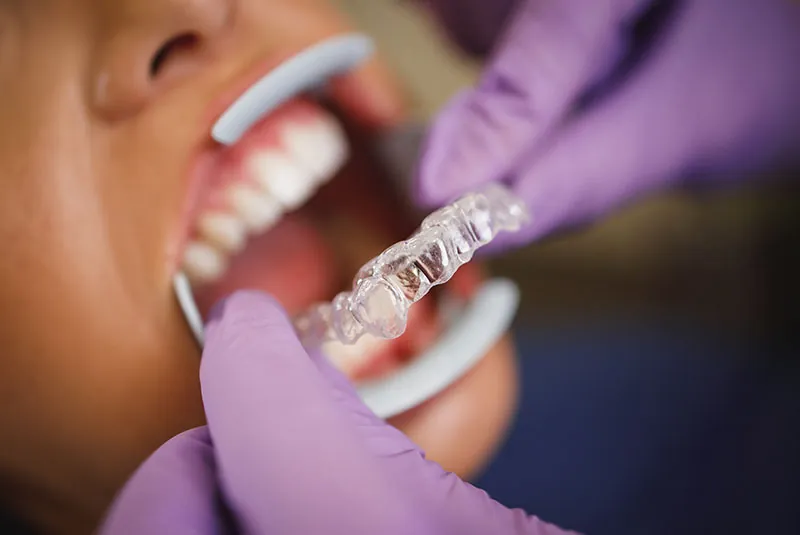
Thankfully, we provide transparent aligner systems as a substitute for traditional braces that deliver comparable results. Patients can enjoy the advantages of wearing transparent aligners while correcting their tooth positioning in a subtle way. Transparent aligners serve as an effective option to conventional orthodontic treatment. Below are several important aspects that individuals should know about transparent aligner therapy.
More Information On Clear Aligners
Detachable and virtually undetectable
Transparent aligners are the preferred option for numerous patients because they can be taken out and remain inconspicuous to others. The transparent aligner system arrives as a series, with each tray positioned differently to systematically guide teeth into their correct alignment.
These aligners are made from transparent plastic material that doesn’t alter tooth coloration and will only be visible when the user specifically directs someone to examine their teeth closely. Due to their subtle appearance, patients won’t need to worry about feeling embarrassed while wearing transparent aligners.
Prior to starting treatment, we must create impressions and take precise measurements of the patient’s dental structure. This information is then forwarded to the laboratory where we calculate the treatment timeline. Throughout the treatment process, patients will switch to new transparent aligners approximately every two weeks, progressing to the subsequent set. Using this method, patients typically experience discomfort only during the initial day or two and will achieve straight teeth sooner than expected.
Transparent aligners can also be removed but must remain in the patient’s mouth for a minimum of 22 hours daily. Should patients need to take out the aligners for meals or athletic activities, they simply need to replace them as quickly as possible. During meals, patients remove the aligners and reinsert them after eating and cleaning their mouth thoroughly. Individuals may also take out the aligners for significant meetings, presentations, social occasions, or photography sessions. Here are several considerations that patients should remember while using transparent aligners.
Not For Childs
Transparent aligners may not be the optimal treatment choice for young children or those in their early adolescent years. Because transparent aligners demand greater personal accountability for maintenance, younger patients often lack the maturity needed to handle them appropriately. In numerous instances, a child might take out the transparent aligners during lunchtime and accidentally discard them along with their lunch packaging.
Children may also struggle to remember removing the aligners for their nightly tooth brushing routine and then reinserting them afterward. Due to these increased care requirements, we suggest that younger patients continue with traditional braces until they demonstrate greater maturity and responsibility.
Transparency Tells the Whole Story
Although transparent aligners excel as a subtle orthodontic solution, patients must clean their teeth following every meal before reinserting the aligners. Patients take out the transparent aligners for eating or drinking and must then reposition the aligners.
Nevertheless, if someone fails to clean their teeth prior to replacing the aligners, there’s a strong likelihood that food particles will become visible within the aligners. Consequently, we advise that patients make an effort to brush or at minimum rinse their mouth with water following each meal.
Avoid Extended Removal Periods
Despite transparent aligners being detachable and requiring removal for specific circumstances, patients must reinsert them relatively promptly. With traditional braces, patients cannot remove them and therefore don’t disrupt the continuous straightening process. However, leaving the aligners out for excessive periods can cause teeth to start reverting to their previous positions.
The extended duration a patient keeps the transparent aligners out, the more prolonged the overall treatment may become. As a result, it’s optimal to only remove the transparent aligners for limited timeframes before returning them to the mouth.
Definition of Invisalign® Terminology
With Invisalign® treatment, the patient will receive a series of aligner trays and swap out each one for the next one in the series every two weeks in order to gradually straighten the teeth.
ClinCheck® software allows professionals to map out the straightening process the patient’s teeth will go through with Invisalign® in great detail.
Incisal ridges are the portion of the crown of the tooth that makes up the incisal portion and can be a direct cause of overbite if they are extended too far.
Malocclusion is the condition in which the upper and lower teeth do not meet properly when the bite is closed. Conditions of malocclusion can include overbite, underbite, crossbite and open bite; all of which are treatable with Invisalign®.
Smart Track® Material
Smart Track® material is in Invisalign® aligners to increase comfort, improve control of movement, increases the speed of treatment and applies a gentle force to the teeth over time.
Vivera® retainers are a type of retainer that consists of clear plastic material and helps to maintain orthodontic corrections after a treatment.
The blue compliance indicator is a small blue dot on the aligners that will fade from blue to clear in order to indicate if the patient is wearing the aligner for the proper amount of time and where the patient is in the Invisalign® process.
The gum line is the line in the mouth where the teeth and gums meet. If a patient struggles with gum recession, then the gum tissue around the teeth may begin to wear away.
An iTero Element® scanner allows professionals to create a 3D image of the patient’s teeth in minutes and predict what it will take to move the teeth into proper alignment.
An overbite is a type of malocclusion that occurs when the upper teeth jut out over the lower teeth, covering them and causing other issues.
SmartForce attachments are small attachments that professionals place on the patient’s teeth before placing aligners to help move the teeth.
Smile-Scan analyzes the way a patient smiles by measuring the position of the mouth and eyes before giving a score.
Discreetly Improve Your Confidence.
I understand the information disclosed in this form may be subject to re-disclosure and may no longer be protected by HIPAA privacy regulations and the HITECH Act.